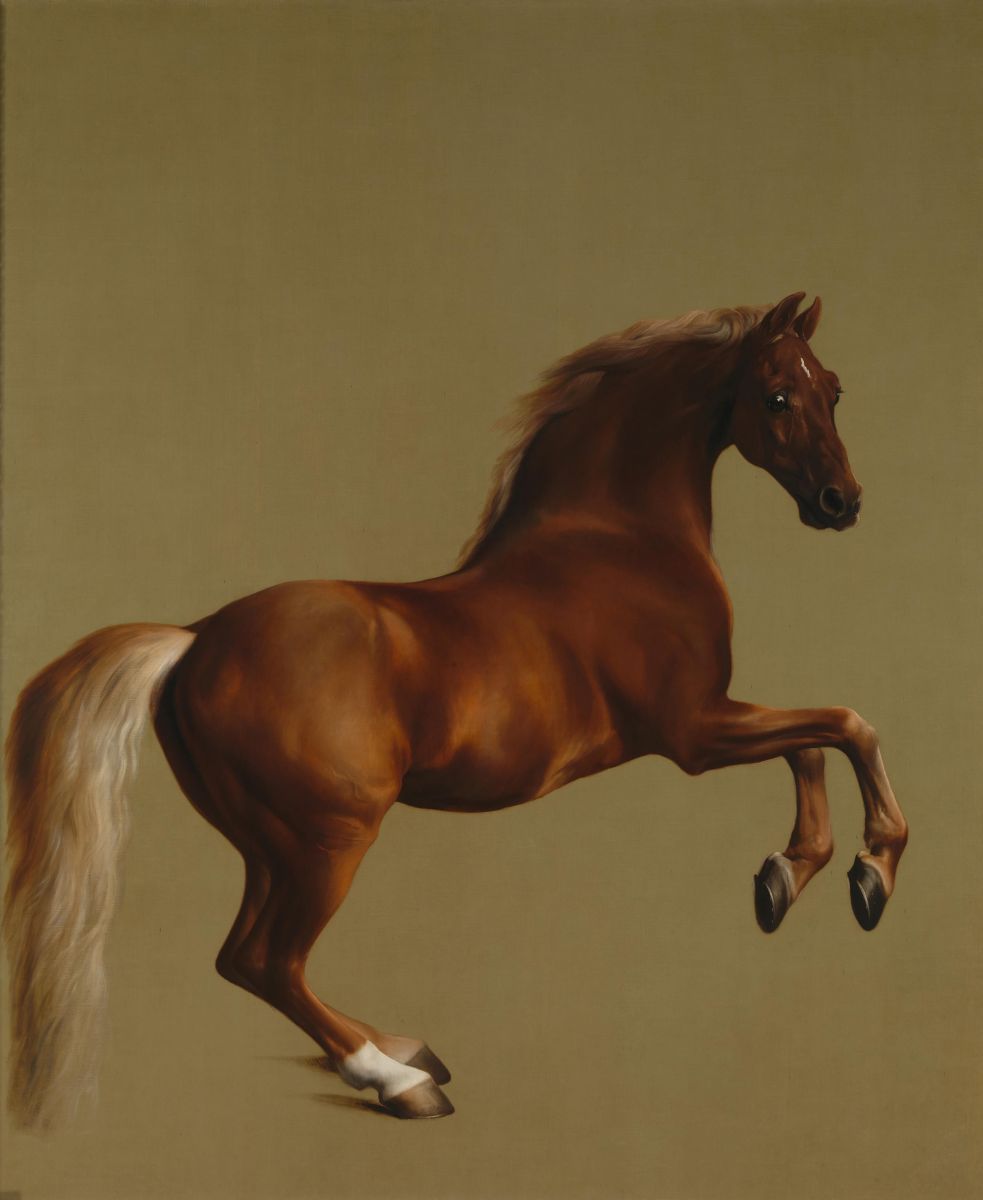
A Whistlejacket painting or Whistlejacket or a portrait of a racehorse beloved by many Englishmen. This work was created by Stubbs in 1762, which is one of the artist's most recognizable and popular work.
An interesting story and partly secret is shrouded in the work itself, which was commissioned by the Marquis of Rockingham, the owner of the horse. This steed won four thousand 2,000 guineas in four-mile races, or as of now, approximately £ 100,000 in 1759. The horse was born in 1749 and was famous not only for endurance, but also for the fact that over the entire period of his career he missed only four races. And the Marquis decided to perpetuate his fame on canvas by ordering a portrait of a horse to the artist Stubbs.
Definitely, the portrait itself is striking in its scope not only in the level of its execution, but also in size, which is almost a three-meter work, where the horse is depicted in full size. The center of gravity of the picture is the horse itself, nothing and no one distracts the canvas from the hero. The neutral background, the missing landscape and the horseman, makes the viewer enjoy the splendor of the horse, which is depicted in a standing upright and galloping racing into space.
The artist was able to convey all the passion, strength, beauty, emphasizing the absence of a rider and a bridle, all the love and romantic attitude to horses, as strong, rebellious and free creatures, but also belonging to a person.
A lot of legends and conjectures are associated with this work, some contemporaries believe that the picture is not finished by the artist due to the disagreement between the monarch and the customer. Others, on the contrary, argue that the shadow under the hoof indicates precisely the completeness of the artist's work.
In the 18th century, horse breeding and horse racing for the English aristocracy were a real passion when horses were perceived not as ordinary animals, but as full-fledged competitors. Stubbs not only fulfilled and took into account all the wishes of the customer, but knowing the anatomy and essence of the horses, he was able to convey all the characteristic features of the horse.
Such as swollen, almost imperceptible veins on the athletic thigh, a white spot on the hoof and forehead. After all, all these signs are similar to human ones, such as a birthmark, blinders and the shape of the eye.
But the artist’s task was not only to reflect and show external differences, but to convey the whole nature and essence of the character and strength of the horse. After all, the whole temper of a horse is expressed in tense, like a string of muscles, energy and love of freedom. Most importantly, Stubbs was able to convey maximum tension and horror on the face of the steed.
There is a legend that the horse attacked the artist, there was such a realistic portrait that the horse thought it was another animal. But this is only a legend.
The Rockingham family kept a portrait of the favorite of their ancestor for more than two centuries, and only in 1997 the London National Gallery acquired the painting for 11 million pounds.
- Total painters: 8606 |
- RU
- EN
Whistlejacket
217
0 like
28.08.2019
BeMyPaint являются зарегистрированным товарным знаком.Все права на содержание опубликованных на сайте www.bemypaint.com текстов и изображений защищены в соответствии с российским и международным законодательством об авторском праве и смежных правах. Любое использование материалов сайта допускается только с письменного согласия правообладател.
Войти через соц. сети: