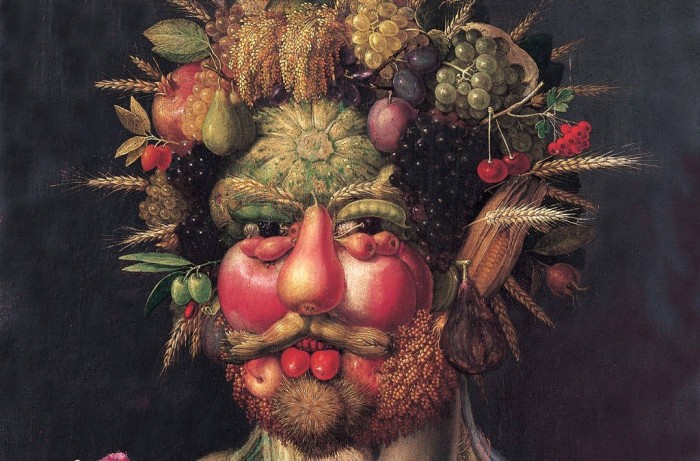
The artist Giuseppe Archimboldo celebrated the 430th anniversary of his birth this year, which became famous for its amazing portraits of fruits, vegetables and flowers. He was the most radical and extravagant representative of the mannerism style, he was able to push the boundaries between the human world and the natural world.
The interweaving of fruits and vegetables form a recognizable portrait style.
But the genre of portraiture has been dominant for many centuries, but in the 16th century, the artist presents his own vision of this genre, filling portraits with still lifes. Moreover, his portraits were extraordinary in content and composition.
The moment of composition itself was more an allegorical look at simple things than just a portrait. Among many art historians, there is still a debate that its paintings are inadequate in the mind or still filled with new experiments of the Renaissance, which, as many know, have always been famous for their riddles, paradoxical views, symbols and innovations.
Archimboldo creates his first canvases under the rule of Emperor Maximilian II. As a gift to the emperor, the artist creates two of his most famous works, “The Seasons” and “Elements”. The emperor likes the artist’s work, he encourages his work, and thereby provides access to collections of rare flora and fauna. To allow you to create a unique portrait from natural images.
Through human forms, through four seasons, he reveals his creativity and the greatness of nature.
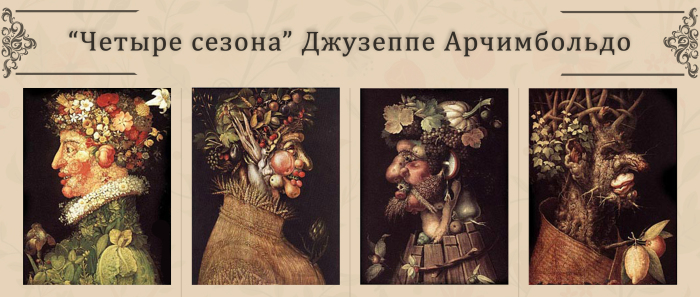
The painting “Four Seasons” is a series of portraits composed of seasonal plants. This series of works is a vivid manifestation of the mannerism genre and was so liked by the emperor that he ordered a new series of the artist’s work. Each of the paintings represents one of the seasons and consists of those objects that characterize this particular time of the year.
But we all remember that his paintings are not just a portrait form, enclosed through objects of flora and fauna, but rather an allegory.
In allegories, it is very clearly shown that under peaceful and successful rule such at first glance, disparate elements and opposing forces can be combined into a single whole.
United by the emperor when he can turn chaos into harmony.
The publication was prepared on the materials of the site kulturologia.ru
Войти через соц. сети: