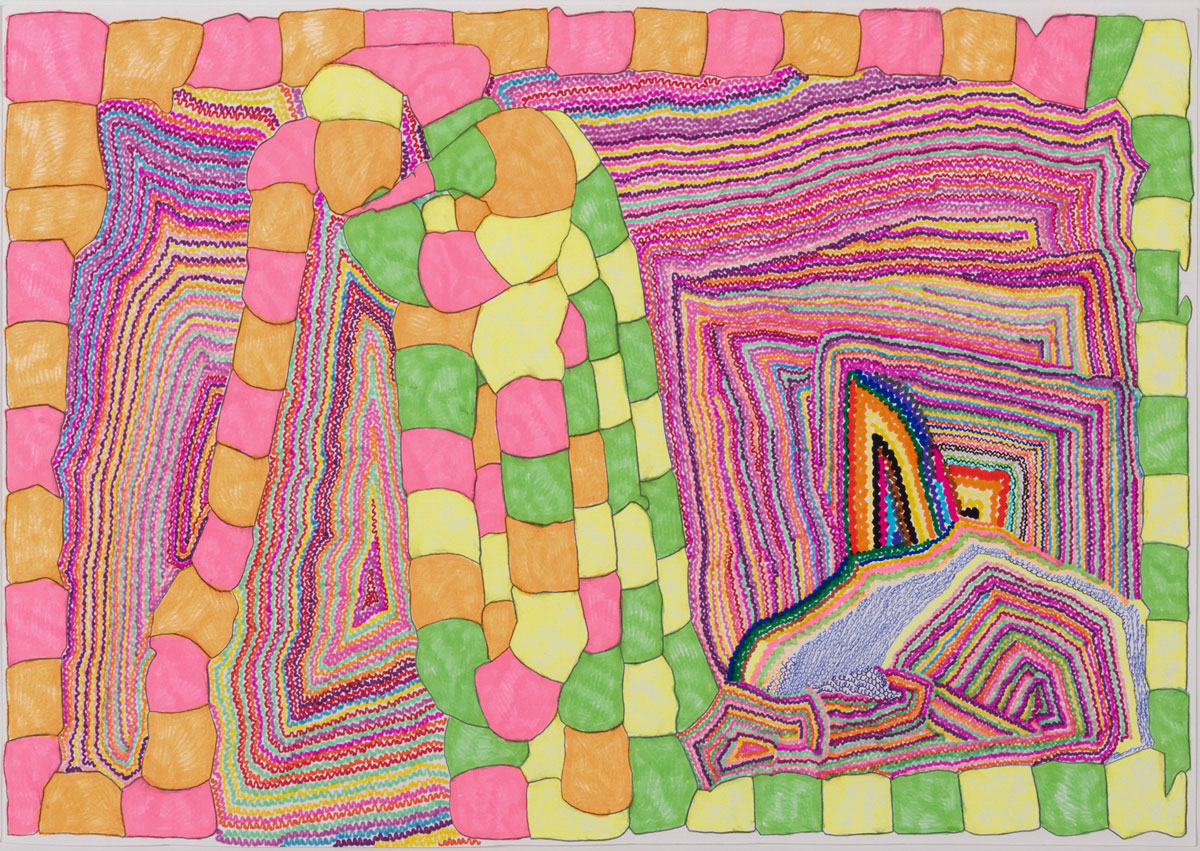
Like many children, Susan Te Kahurangi King used to draw crayons for hours, filling entire pages with bold lines. Unlike many children, she was like a child prodigy from the very beginning, which at the age of five was praised by an elementary school teacher for her ability to convey complex figures. The eldest of 12 children, King was inspired by her parents, who always supported the young talent and equipped a special place for painting at home, and decades later she became one of the most famous draftsmen.
Born in The Aroha, New Zealand, King, now 68 years old, painted several thousand drawings in her career, most of which were forgotten. But recently, everything changed when the artist Gary Panther found out about King’s work and in 2013 he was able to see some of the works that were filled with animated pop cultures. Subsequently, on Facebook, Gary shared these drawings with his subscribers to his friend, the famous art dealer and curator Chris Byrne, who was so inspired by King's work that he was able to organize a number of exhibitions around the world.
“She's really a master at reconfiguring objects and objects from popular culture and creating scenes whose values are left up to the viewer,” said Alison Amik, curator of Intuit Chicago Gallery, who worked with Byrne to organize the show. “The more you look at Susan’s work, the more you can reveal and understand.”
Organized in chronological order, the show talks about King's unusual, changing interests. At the age of seven, she was obsessed with Donald Duck, twisting his body into pretzels and clipping him, turning his form into witty vulture requests. And later drawings made by graphite and colored pencil, which show complex mishmash of planes and perspectives. Characters such as Woody Woodpecker, Bugs Bunny, and the grinning clown (the mascot of Fanta's soda) sweep through them, each of whom is apparently lost in his own world.
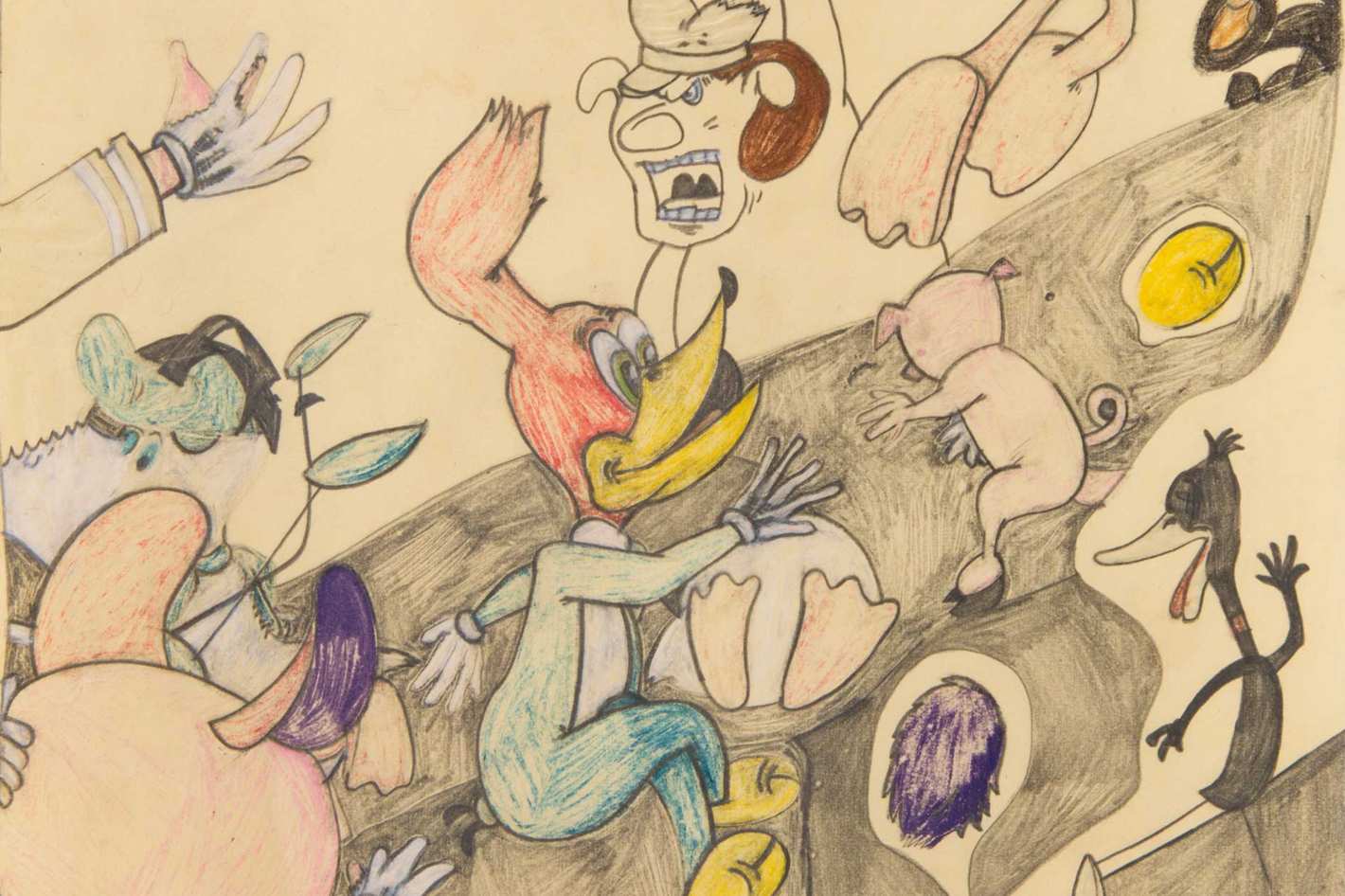
Dense labyrinths of troubled characters such as these were key during what King’s younger sister Petit Cole calls the artist’s “period of rich painting” in the late 60s and 70s. Curiously, among the bodies that collapse or collide with each other, King often left part of her paper canvas completely white, as if creating a moment with intricate lines for great sensations.
Many critics who wrote about King’s work attribute the mystery of her drawings to the fact that she stopped speaking completely at the age of eight for unknown reasons. It may be easy to capture this detail of her biography, especially given her dramatic last words spoken to grandparents after the funeral: “Dead, Dead, Dead.” But the urge to analyze the consequences of this silence may limit our interpretation of the drawings, according to Cole, which warns against reading her sister's work as a form of communication. “I think this is a process and an expression of myself, my feelings, my understanding of my hobbies,” Cole said.
For visitors looking for some kind of guidance in the world of King’s coup, Intuit Gallery combines their drawings with an exposition of photographs and objects from Cole’s personal collection, such as plastic cars and the figure of a mutant teenage ninja turtle — objects that King saw would be around her, at home or traveling with her family. There are also useful objects, such as a rubber bathing cap and a metal meat grinder, which are depicted in some of King's drawings in the form of heads of figures. A keen observer, she sometimes surprised her family with some of the things she depicted, such as a set of phalluses.
“She has an amazing memory for recording the details of all the things that you see in her drawings,” Cole said. “She needs to see something only once, and it’s in her head.”
Cole often describes his sister's practice as "intrusive." Even on the beach, away from art supplies, King drew lines in the sand, as shown in a beautiful black and white photograph at the exhibition. But her fruitful work stopped in the early 90's, when she completely stopped painting. According to Cole, King was "depressed not only psychologically, but also physically." Many of her siblings also left the house. She started painting again in 2008, after family members begged her to take a pen. Meanwhile, Cole began to teach children with autism, and she noticed similarities in the behavior of her students and her sister; King was later diagnosed with the disorder.
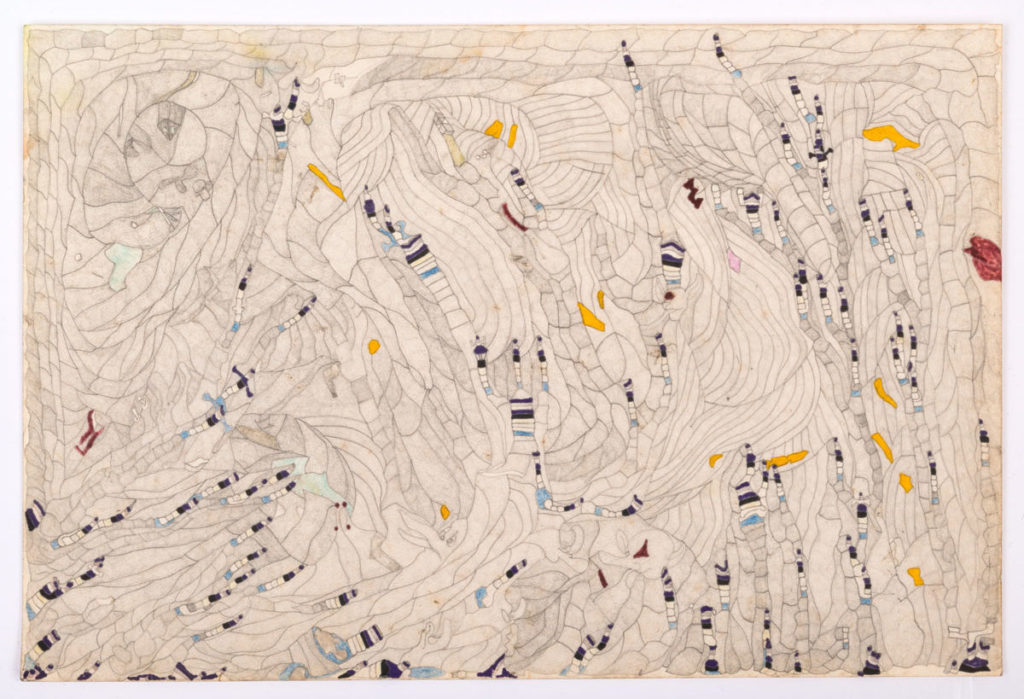
In the works of the artist of the last decade, a noticeable stylistic shift is observed. Made mainly of ink, graphite and felt-tip pen, these elements no longer have cartoony quality and, on the contrary, are very abstract. Individual King's figures disappeared, they were replaced by energy paths of color, which freely intersect or meander lines around each other. It is not so easy to get lost in these paintings, but they are still expertly drawn, and their compositions are created wisely.
Incredibly, the King family kept all of their children's drawings. Her late grandmother saved her early work, and she even went so far as to meet and describe these parts in diary entries. Cole continues these efforts, and since 2005 has methodically archived his sister's creations, processing box by box until the work is completed. “That's not all,” she said.
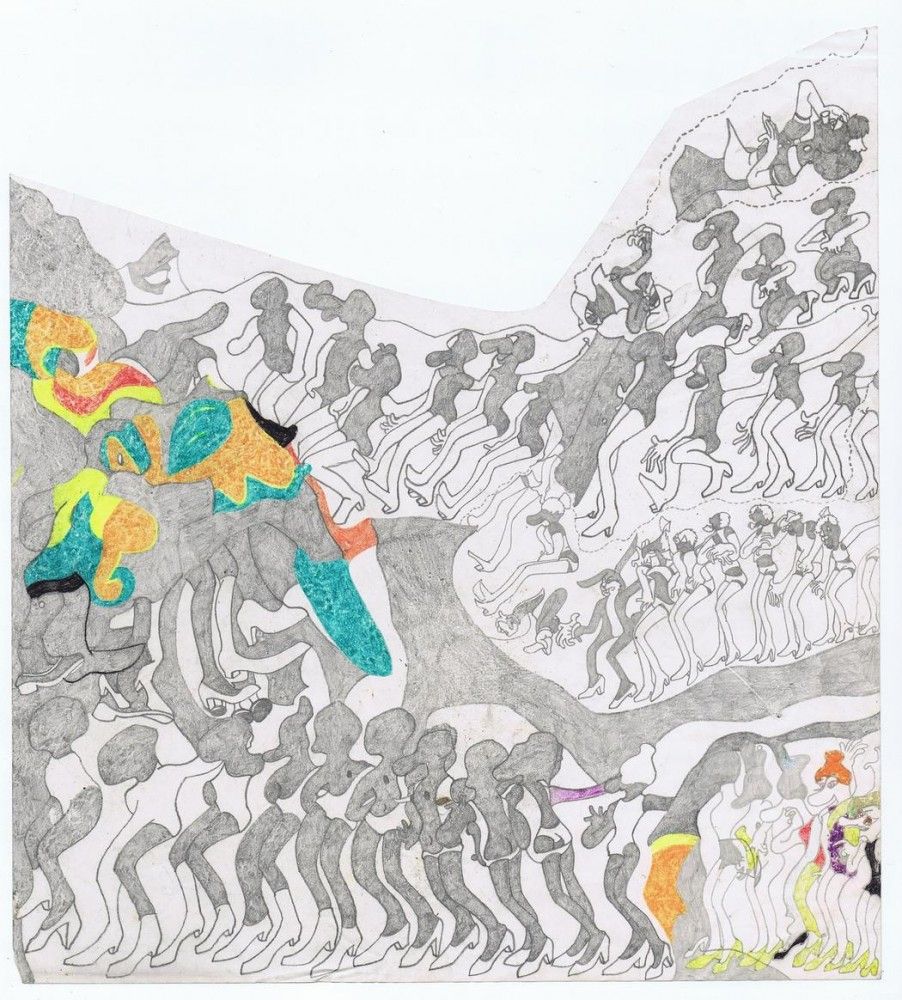
The imaginary unimaginable world is concluded not only in the hearts of one person, but if there is a drop of the universe in the heart of the artist, then he reveals to us the galactic world of the unidentified, but created from above.
You can also familiarize yourself with the publication in our Blog - “Pictures from My Dreams”, where we talk about the artist Trushkova Mila.
The publication was prepared on the materials of the site artnews.com
Войти через соц. сети: