In 1848, the wreckage of the revolution stained the streets of the city, leaving its growing population in poverty and stench. In response, Napoleon III instructed the city planner Baron Osman to remake and modernize Paris to become the pearl of Europe. For 17 years, the capital has been destroyed to create an interconnected network of long avenues, wide boulevards and new bridges, freeing up space for new buildings, such as the Palais Garnier Opera House. Public life now passed along tree-lined streets and parks decorated with street furniture, in cafes and theaters, and on atmospheric roofs. At that time, grandiose fashion houses were created, and magazines around the world represented high fashion.
Edouard Manet was born in Paris in 1832, he was a wealthy man. He was an ideal admirer of this new world - a man who had the time and freedom to watch it all with cool detachment and capture it in pictures of people's daily lives, social events, and public scenes.
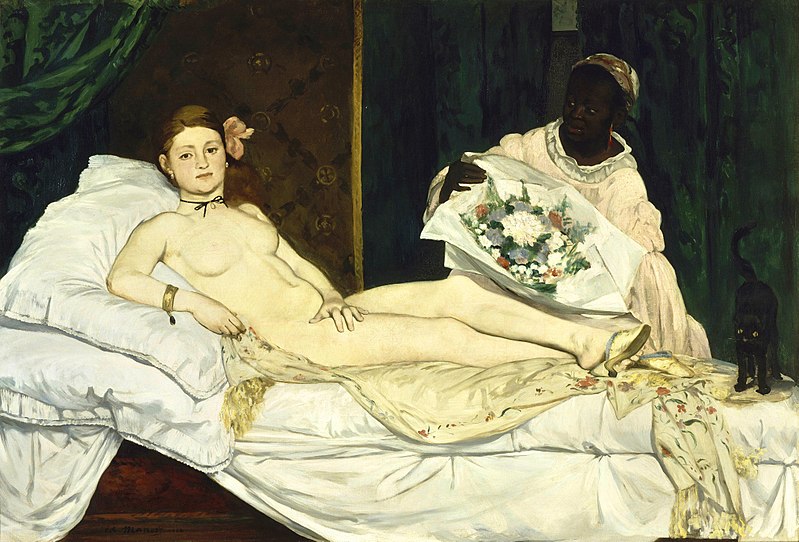 Édouard Manet, Olympia, 1863.
The permanent collection of the Musee d'Orsay in Paris now has 49 works by Mans. However, when the artist died in 1883, when he was only 51 years old, he left a studio full of paintings, for which his widow Susanna was trying to find buyers. His "Olympia" (1863), now his most famous work, which many declared the beginning of modern art, remained unsold. Although the impressionists admired his work, he received little support from the art council. When Olympia (1863) was introduced to the Salon in 1865, he was immediately greeted with intense criticism and denial. The painting was hung very high to protect it from physical attacks. From this height, the straight, even confrontational, gaze of a slender white woman in her center, the courtesan, breaks for an instant. She lies naked in her deck chair lying on a floral shawl, wearing no more than a few accessories: a black ribbon necklace, pearl earrings, a wide golden bracelet, one pink orchid in her hair and Louis XV shoes on her crossed legs. At that time, it was undoubtedly even more difficult to discern two parts of the picture that were usually ignored in the work: a screeching black cat at the foot of the bed and a Black maid standing behind a naked woman, giving her an exquisite bouquet of flowers.
At dusk in Paris, Osman's gas lamps were lit, and the “absinthe hour” began on the boulevards, where working women and their suitors circulated among 200 legalized brothels and closed houses. The scene at Olympia (1863) was modern and uniquely Parisian, and this was a crime: it offended the conservative values of the bourgeoisie, exposed their truth. The picture had its supporters, though. Mane's ardent defenders later organized a posthumous public subscription, collecting 20,000 francs so that Olympia (1863) would be acquired by the state. In November 1890, it was accepted by the Museum of Luxembourg.
In subsequent years, countless art historians have carefully studied this work, and some feminist scholars have noted it for recognizing the power of Olympia's shameless participation in sex work. Her personality is known: Quiz Moran, a friend and artist in her own right, who was the model for the picture. However, the black model has remained essentially nameless - apparently unworthy of the subject in the history of art - for the past 150 years.
That all changed a few years ago when a Ph.D. candidate at Columbia University, Denise Merrell, published a dissertation entitled “Seeing Lor: Race and Modernity from Olympia Manet to Matisse, Berden and Beyond” (Columbia University, 2013). Her work broke the silence around a French Caribbean woman named Lore and turned into an ambitious curatorial study of black models in Western art from the 19th century to the present. The first publication of her doctoral studies was opened at the Wallach Art Gallery at Columbia University in New York in 2018 as “Posing Modernity,” and earlier this year the exhibition at the Musee d'Orsay was significantly expanded to include archival materials, personal correspondence, and films called Black Models (until July 21).
Thanks to Murrell's new interpretations and deep research on key periods of social and artistic history, worthy new biographies were created for previously unknown black muses, as well as new names were proposed for the works of Gericault, Matisse, Gauguin, Picasso and Cezanne, where the image was previously reduced to “Negro” , “Mulatto” or “câpresse”. for Marie-Guillaume Benoit in Portrait of a Black Woman (1800), for example, Murrell proposed Portrait of Madeline, Image of Benoit about Madeleine - a translucent image of a thin black woman with a touch of mahogany - secondary to her deep shade, you notice her naked right breast and stoic look. Her white Empire-style dress is accentuated by a blue shawl and red ribbon tied around her waist, which is a clear reference to the French tricolor. Shown at the Salon of 1800, just six years after the first abolition of slavery in France, Benoit hid the name of a recently released young woman from Guadeloupe who came to France as her son-in-law's domestic servant, probably fearing a refutation daring to portray this black woman as an emblem of the French of freedom. One critic, Thevenin, lamented Benoit's portrait as "the sublime blurry Tache" [Blur], lowering Madeline to unclean inconveniences unrelated to humans. Even the relative freedom that Madeleine and its fellow Black Antilles won did not last long - in 1802 Napoleon would restore slavery in the French colonies.
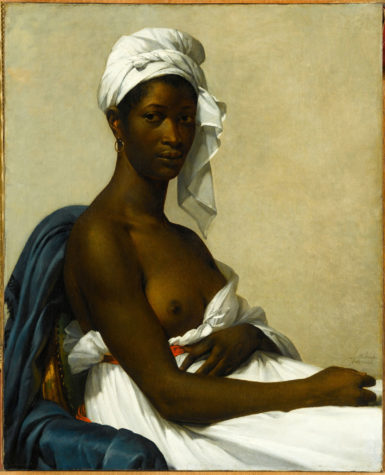
Marie-Guillemine Benoist, Portrait of Madeleine, 1800.
The exhibition also spoke about the growing communities of black men and women in 19th-century France. At that time, black women often worked as nursing sisters in high society families, convinced that they produced high-quality breast milk and had good parenting skills. And the second and last abolition of slavery in the French colonies in 1848 led to the expansion of the presence of blacks in Paris, especially in the northern ninth and seventeenth districts, where Manet and the Impressionists lived in the 1860s. Mane's notebook confirmed that Lore herself lives at 11 rue Vintimille, just 10 minutes from Mane's studio.
It is known that Manet made two more paintings of Laura within 12 months, outside the notorious Olympia. In the book “Children in the Tuileries Gardens” (1861–1862), we see a dark-skinned nanny on the right side of the picture among the family of her employer, where everyone can walk around the Tuileries, potentially on the way to the Louvre. Four gracefully dressed children wander around the park, while the smallest of them sits in front of the relaxed lore in the shade of a tree. And in La négresse (Portrait of Laura) 1863, wide strokes of dark brown makeup around her round face and neck sit against a deep olive background, while the rest of her body is covered in a simple dress with bare shoulders. Her natural hair is covered with a bright head. Laura's portrait looks more like an etude, and not like a finished picture, but, despite its blurry lines, the central point is unmistakable: a smile on her face. At the end of 1862, in a book owned by Mans, the note describes the model “Laure, trés belle négresse” (Laura, a very beautiful black woman).
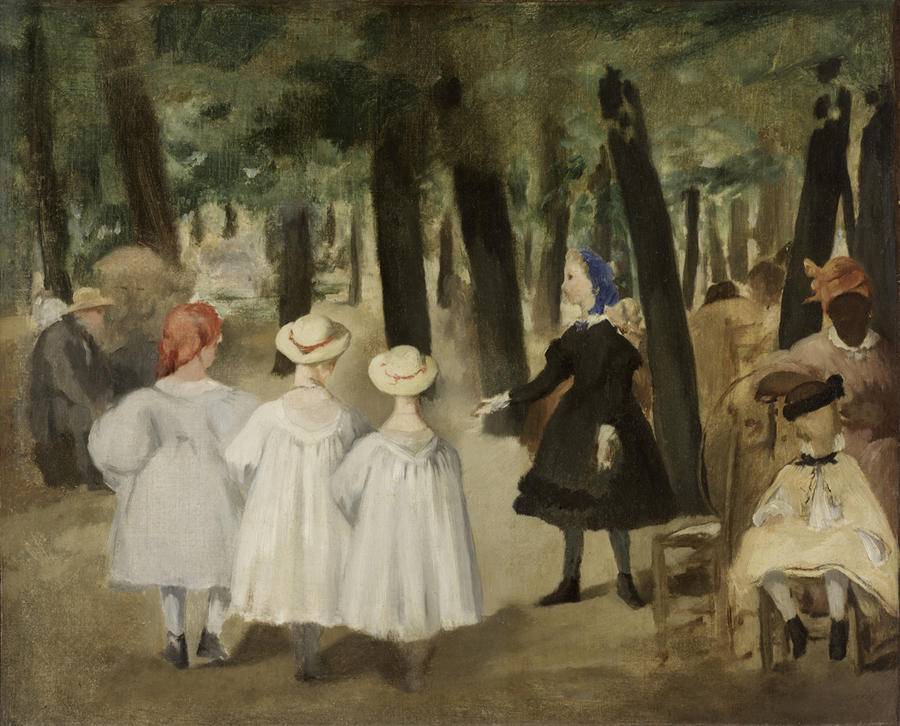 Édouard Manet, Children in the Tuileries Gardens, ca. 1861–62.
Mane’s brief but pointed fixation on Laura involved him, portraying her not as an exotic other, but as an individualized member of the French working class in a small, visible, but marginal black French community. We will never know the complete history of Laura, but now at least she has taken a specific place in the history of art and was presented by Murell as an autonomous person. As the curator said: “I wanted to make it clear that Lore is not an imaginary figure. She is a representative of the racial reality of Paris in the 1860s. “I wanted to show that she occupies one of several social roles occupied by free black Parisians at this particular moment.”
The publication was prepared on the materials of the site artnews.com
Войти через соц. сети: