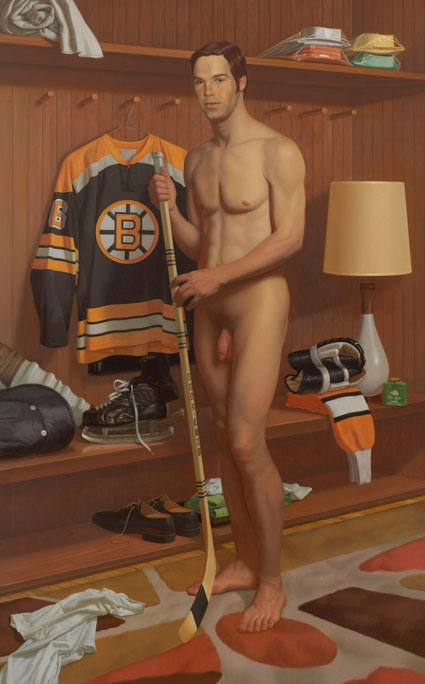
In November, Architectural Digest, as reminded to its readers, was the home of art dealer Jeffrey Deutch in Los Angeles, which owns the work of art, the house that once belonged to actor Cary Grant, and on the living room wall of Deich is a picture of the artist Kurt Kauper full size. The artist's picture is incomprehensibly nude located in one of the beautiful tiled corridors of the house. In 2003, Deutsch showed a new series of naked paintings by Grant Cowper in his New York gallery. Four years later, he showed a series of nude former artist hockey players - Bobby Orr and Derek Sanderson Bruin, who, like Grant's paintings, were made by Cowper on the basis of photographs.
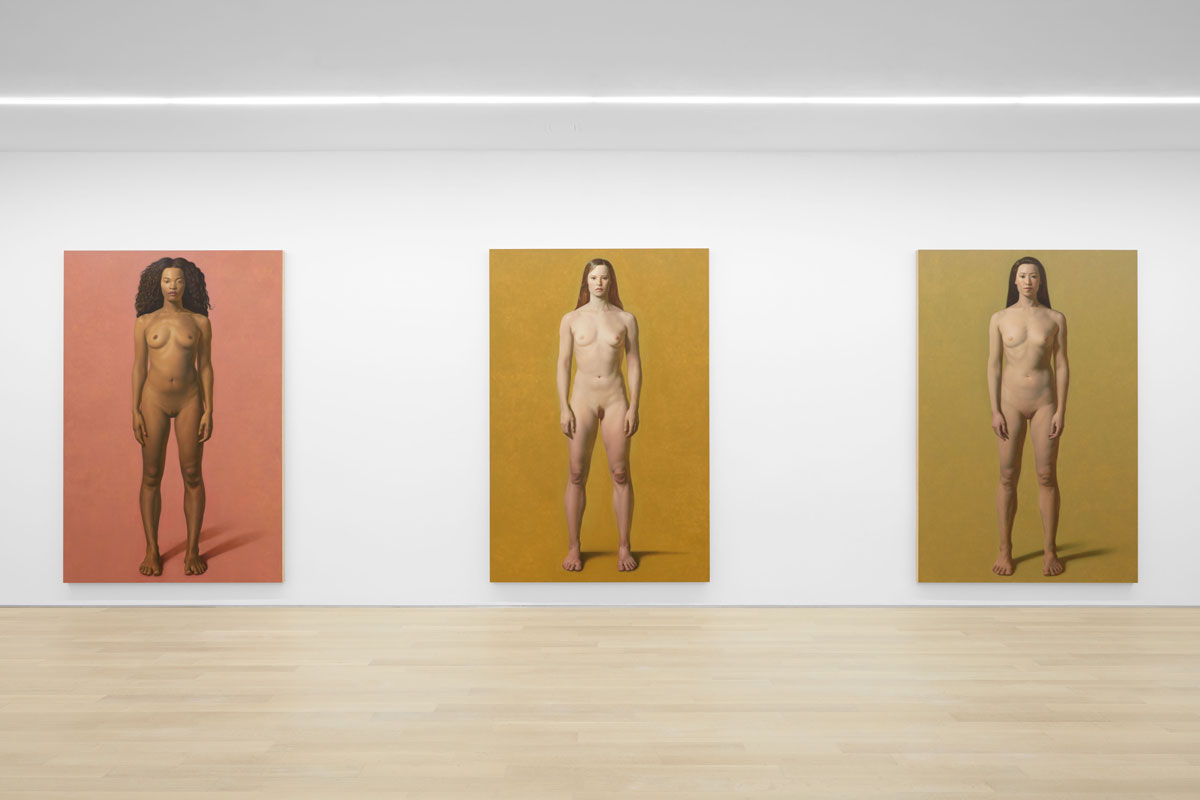
On one wall were hung three pictures of naked women the size of a man's height, which led around the room, a little frightening with their appearance. They are painted on flat, minimalist grounds, each of which has an indefinite color, one pinkish, the other greenish and a third mustard tone. Women's legs firmly on the ground in such a way that they draw attention to the figures they support. The effect is a bit strange, given their apparent strength and assertiveness, as well as androgyny - the feet are perhaps the most sexually ambiguous aspect of solid looking women.
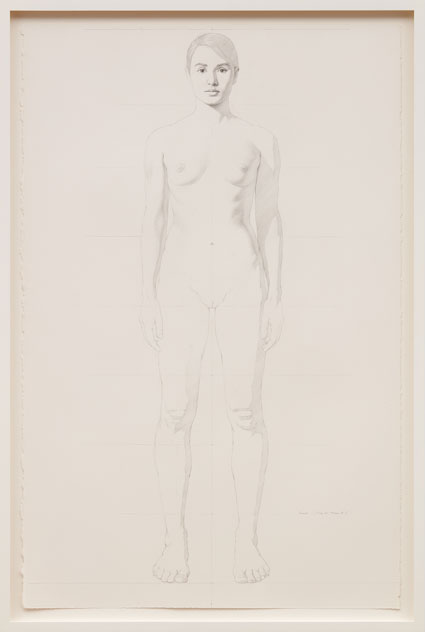
While over the past few years, Kauper held a low social position when he was looking for new directions for his paintings, the renewed interest in the design today and the subtle anomalous style to which he came again attracted attention.
Where Kauper’s early works were shocked by their content, they do so because of their shameless impenetrability, the stately, soldier’s postures of their subjects and their gender-challenging manners — or what Cowper prefers to call his “neutrality.”
For Cowper, the creation of “Neutral” means the creation of an image or idea that lies between genres, definitions, sexuality, susceptibility, that is, ultimately, “uncertain”. Philosopher Roland Barth was the source of the term, saying, "I define neutral as something that transcends (déjoue) the paradigm, or rather, I call everything that baffles the paradigm neutral."
52-year-old Cowper studied at Boston University, where, according to him, there was a strong figurative tradition. “I was looking for a version of traditional learning that was not so traditional,” he said. “I learned from a group of teachers who were real German expressionists or influenced by German expressionism. But I remember how they said to me: "All art died with Matisse." And they also said: "Regardless of whether you look at Picasso, all that matters is the movement of volumes in space." Thus, they thought that they could understand art solely from the point of view of a certain formal line that passed through the early Renaissance to Picasso. This kind of thinking just seemed absurd to me. Artists who ignored the formal aspects of art, but emphasized the conceptual.
He met one of those artists who emphasized conceptuality when he attended graduate school at the University of California at Los Angeles, where he became friends with Charles Ray, a figurative, hyper-realistic, almost surrealistic sculptor and installation artist. Both artists are masters of the supernatural.
Reflecting on his own evolution and artistic influences, Kauper recognized Ed Rush and Ray ("one of the best artists of his generation"). “But also,” he said, “when I was a teenager, my favorite artists were people like Ingres, who is still my favorite.”
“What Kauper does in painting,” said Jeffrey Deutsch, “is essentially what Rey does in sculpture.” One of the special skills that Kurt possesses is creating the illusion of weight with the help of these figures. And in addition to the fusion of conceptualism and configuration, there is also a great combination of abstraction and configuration. ”
“Kurt,” he added, “looks like a writer and inventor. These figures are as close to abstraction as you can get with a perfectly traced figure - they are deliberately deprived of individuality; they are formal; and they reject female power. "
Deutsch called Kauper "the most modern painter", although his paintings and figurative, not engaged in telling stories. Rather, the “indeterminate nature of his images is that they are“ built fragments ”and therefore open to interpretation.
Cowper said he did not want to paint a nude woman, because "it was such a good one that many artists of all times used." When I first came out of graduate school, the return to figuration was very widely covered, and then many of these outstanding artists painted naked women - [John] Kerrin, [Lisa] Yuskavage, Will Cotton, [and Martin Eder. ” He added: “If you define it very broadly, people like Vangechi Mutu also dealt with a naked woman. I did not want to fall into the trap of returning to a certain conventional notion of desire. ”
A couple of years after the completion of his hockey players, he decided that he would break his own rule.
“When I began to think that I had set the ban, I wondered if it would be interesting for me to question this ban,” he said. “I thought that if I'm going to draw a female nude figure, I want to draw a female nude that does not return to the usual representation of common desire. Not that I disliked many of the artists who do this, and you know that Kerrin is probably my favorite artist of that generation, but I just didn’t want to repeat myself. ”
He wanted to use a tradition that tries to “undermine” this common desire. Probably, this is where the concept of "neutral" came.
Settlement in poses was not an easy task. He started with a naked woman with her hands on her hips. But "even this minor gesture contained too much," he said.
“It seemed to unleash my actions too much, filled with meaning. And I just became interested in these perfectly straight, rectilinear figures, to see if I can find a different approach to the female nude body ”that doesn’t refer to the viewer as we know it.
He finished the first of the paintings in 2015. (He started it in 2010, and then “other things, both personal and professional, intervened,” he said.) He began the rest several months later. At the end of the same year, Deutsch and Larry Gagosyan included pictures of hockey player Kauper in their exhibition “Unrealism” in Mura's building in Miami during Art Basel Miami Beach. Among those who saw them were the art dealer Almine Recz and her husband Bernard Ruiz-Picasso, Pablo's grandson. Shortly afterwards, Rech contacted Cowper about the exhibition.
“I found that people who have deep knowledge in historical art, who are not part of the New York trend, can really relate to Kurt’s work,” said Deutsch, “so it’s important that dealers Almine and Bernard with their experience , was intrigued by this. "
By the way, about the backgrounds. Inspiration for the mustard tone of this naked figure may have come in part from an unexpected source, racehorse artist George Stubbs. Deutsch remembered how Kauper told him that he was inspired by the picture of Stubbs Whistlejacket or Whistlijacket (1762).
“So Kurt did it,” said Deutsch. “I have never seen anything like it, where he demonstrates the tradition of drawing race horses. This makes the assessment of his work much more interesting. Because they are in a dialogue with modern problems, very relevant gender issues, a very modern discussion, but they return to the question of how to create a picture that has 250 years. ”
The background for the artist is the deliberate elimination of the narrative.
“I recently realized that, in a sense, I am a formalist,” he continued, “at least in the sense that what motivates me to do my work is always an existing form. And then the challenge is how to expand the ability of this form to participate in modern discussion. ”
This publication is based on artnews.com
Войти через соц. сети: